
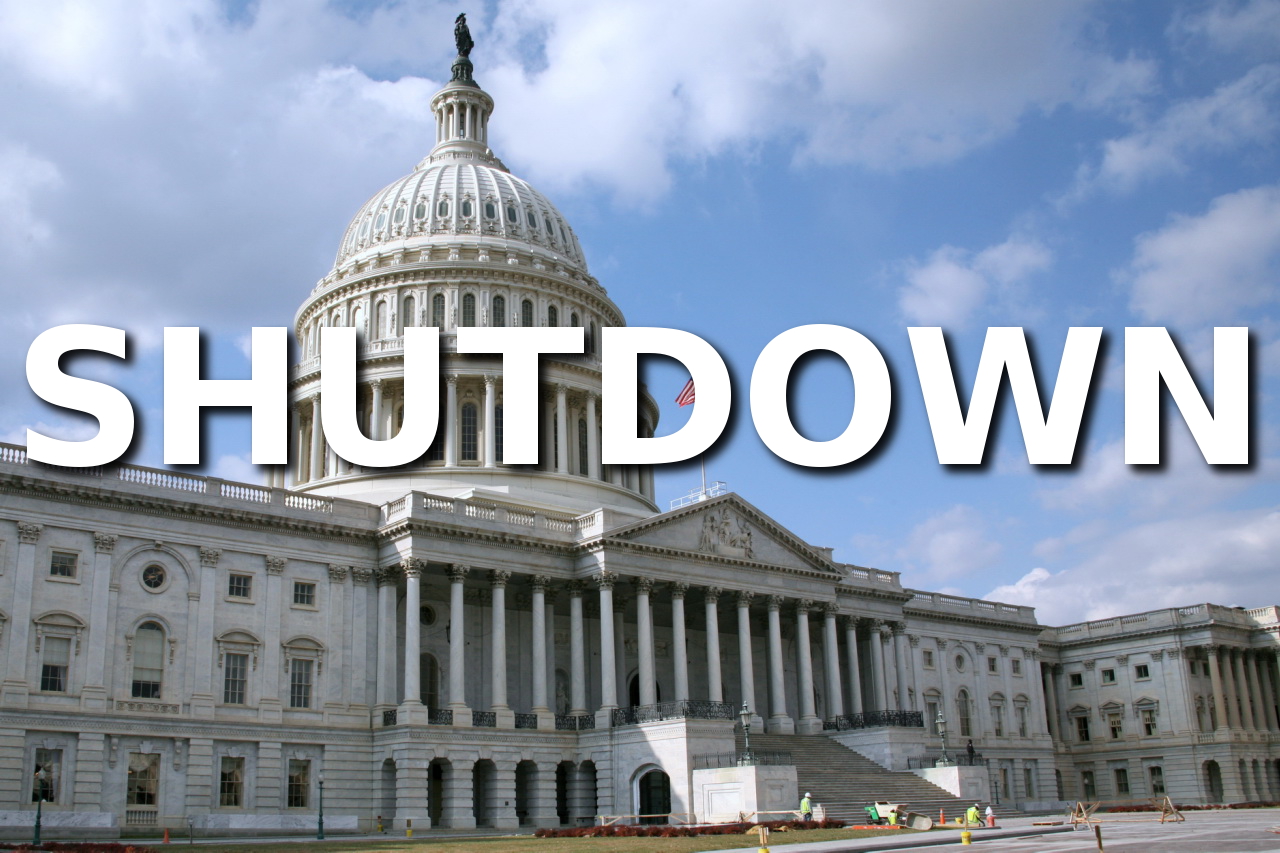
The Senate is expected to vote this week toward avoiding a government shutdown on October 1. With little support coming from the House though, it is likely we will see the government shutdown next week. The only real hope is a coalition of moderate Republicans and Democrats working together to pass something this week.
Congressional Republicans are holding up the continuing funding resolution due to a debate over funding Planned Parenthood. This began with videos which showed Planned Parenthood officials discussing payment for procuring aborted baby tissue. These videos have caused an uproar among conservative members of the house and they have been weighing whether to try to strip federal funding for the nation's largest provider of abortions in a spending bill that must be passed before the government’s current funding expires on September 30.
A government shutdown results in non essential portions of the government being shut down. Vital portions would stay intact such as the USPS, Department of Defense, Social Security, Medicare and Medicaid.
Most of the government actually isn't affected at all, and often even those who are still have workers performing their job functions.The shutdown, saw roughly 800,000 federal employees sent home and national parks and services closed. Most of these employees however continued work from home on their projects unpaid until the shutdown ends. They were then given back pay for this time period.
The 16-day shutdown in 2013 also stopped the creation of an estimated 120,000 new jobs, according to one report by the Council of Economic Advisers. It dug into the GDP for that year by over 24 billion dollars. Considering the instability in China's markets and with several countries around the world, this is not the time for the government to be causing any decline in economic output.
Until recently, Senate Republicans had indicated they would likely wait to see what kind of spending bill would be passed by the House, where there is greater GOP opposition to any spending measure that includes Planned Parenthood funding. Since the House is only in session for a short time this week and has no such measure on it's calendar the Senate looks to be attempting to act first.
“It’s an exercise in futility," Senate Majority Leader Mitch McConnell said in an interview with Politico. "I’m anxious to defund Planned Parenthood" but "the honest answer of that is that’s not going to happen until you have a president who has a similar view."
This comes as presidential hopeful Senator Ted Cruz has stated his opposition to any bill allowing Planned Parenthood funding. "In light of recent and horrific revelations that Planned Parenthood is trafficking in fetal tissue and body parts from abortions, we urge you not to schedule or facilitate the consideration of any legislation that authorizes or appropriates federal dollars for Planned Parenthood."
Last month he also stated, "I believe we should use every and any procedural tool available to defund Planned Parenthood."
Other Senators have criticized Ted Cruz for his views on a government shutdown. "Given the challenges and threats we face at home and abroad, I oppose risking a government shutdown, particularly when it appears there is no chance of achieving a successful result. Nevertheless, as I understand it, you have been circulating a letter to our colleagues asking them to oppose any government funding bill that continues to authorize funding for Planned Parenthood. … How do we get 60 votes? And if for some reason there were 60 votes, how do we get 67 votes in the Senate to overcome a Presidential veto?” Senator Kelly Ayotte asked in a recent letter. “During the last government shutdown, I repeatedly asked you what your strategy for success was when we did not have the votes to achieve the goal of defunding Obamacare, but I did not receive an answer."
With fears of the economic effects a shutdown could have, industry leaders are calling for compromise. "A democracy is a compromise by its nature. It’s not a dictatorship. So anyone who says, “my way or the highway on one issue,” isn’t necessarily thinking about the United States of America. And so I wish people to overcome that kind of stuff. A government shutdown is just bad management."JP Morgan Chase’s CEO Jamie Dimon said in a recent interview with MSNBC.
Many Americans view it as that; failed leadership by both parties that is leading to a shutdown. A lack of compromise lead the last Congress to be the least effective in history. There is a strong belief that the extremism we are seeing in Congress, displayed in the house especially is directly linked to the gerrymandering of districts throughout the country by both parties. This gerrymandering guarantees seats and power at the cost of extremism. This has lead to the rise of the Tea Party and concerns over the debt ceiling being raised and government shutdowns.
With less than 9 days to go before a possible shut down, it is becoming more and more likely that Congress will not be able to pass a funding bill in time. Democrats are unlikely to back down, and President Obama has already promised he will veto any bill that defunds Planned Parenthood. Some have argued that it was not the founders intent to use the veto as a partisan tool, but rather as a constitutional safe guard against abuse. Others point that this authority has been used in this manner for decades. Needless to say, if this shutdown lasts longer than the one in 2013 (16 days), it could become very costly to our economy and our government.


