Showing posts with label Republican Party. Show all posts

Sunday, November 8, 2020

Where do we go from here as a nation?

The 2020 election concluded when the last polls closed on November 3, 2020. In the following days, final vote tallies were completed, some states conducted recounts, and the process reached its conclusion. There is little doubt that the outcome—a Biden victory—will remain unchanged. The question now is: where do we go from here?

The past two decades have been among the most divisive in modern American history. Our nation bears deep wounds that must be healed, with divisions that have been exacerbated by increasing tribalism and partisanship. It is imperative that we learn from recent history and find a way to move forward together. The challenges ahead demand unity, and the way we have operated over the last twenty years cannot define the next decade.

As a lifelong registered Republican, my lack of support for Trump has never been a surprise to those who know me. There is a common misconception among Trump supporters that opposition to him stemmed solely from partisan loyalty. However, I did not vote for Clinton or Trump in 2016, fully aware that my preferred candidate would not take office in 2017. My opposition to Trump was not about party allegiance; it was rooted in disagreement with many of his policies and leadership style over the past four years. In the same way, I opposed Obama on numerous issues throughout his presidency, while also acknowledging his successes. Like anyone, I have personal biases against Trump, but I have also made a conscious effort to listen to his supporters, to understand their frustrations and aspirations. Many of them feel that their faith, their vision of America, and their political ideology have been under attack for the past twelve years.

At the same time, there is a misconception among many Democrats that Trump supporters are predominantly ignorant or racist, that they harbor hatred toward people of color and embrace bigotry. From my experience, this is simply not true. Many Trump supporters are compassionate, decent people in their everyday lives. Their support for Trump was based on a variety of reasons, and if we are to move forward as a nation, it is critical that we listen and seek to understand those reasons.

There are good people in both parties. What we must stop doing is labeling and dismissing each other. Instead, we should commit to listening more, engaging in thoughtful reflection, and striving to find common ground. I personally am making a commitment to listen and reflect more, and I hope that in the coming years, others will do the same. Reuniting as a country requires meaningful dialogue, especially with those we disagree with. We don’t have to agree on everything, but we should strive for compromise and progress. I hope this shift occurs not only in Washington but also in our own homes.

May God bless America.

Wednesday, February 19, 2020

Beyond Red and Blue: Breaking Free from Political Tribalism

Our country is deeply divided—on politics, religion, culture, and more. The divisions are growing, fueled by an “us vs. them” mentality that does more harm than good. Instead of seeking common ground, we often build walls between ourselves, seeing political opponents as enemies rather than fellow citizens with differing viewpoints.

One of the most frustrating aspects of this divide is the way arguments are framed. Straw man arguments dominate the conversation, reducing complex issues to oversimplified attacks.

For example, some people point to certain states to argue that one party is superior to the other. California (a blue state) has problems. Mississippi (a red state) has problems. Neither party controls an entire state from top to bottom, and no county in America votes 100% for one candidate. The reality is far more nuanced than "blue states bad" or "red states bad."

Likewise, labeling an idea as "left" or "right" doesn’t shut down the discussion—or at least, it shouldn’t. Policies should be judged on their merits, not on who proposes them. I agree with Bernie Sanders on campaign finance reform, but I also disagree with him on other issues. The same goes for Biden, Trump, Warren, Cruz, and Paul. No politician is right (or wrong) about everything. Even Sanders and Cruz have voted together at times.

Yet, we often reject ideas not because of what is said, but because of who said it. This is the essence of tribalism, or what I like to call “team sports politics.”

The Problem with Team Sports Politics

Think about a die-hard football fan. If you ask a New England Patriots fan whether Tom Brady cheated, they’ll likely deny it. But ask almost any other NFL fan, and they’ll say he absolutely did. Their judgment isn’t based on facts—it’s based on loyalty.

The same thing happens in politics. People dismiss or accept ideas based on party affiliation rather than evaluating them critically. Imagine taking a quote and presenting it as either from Bernie Sanders or Ted Cruz—the reaction would often depend more on the name than the content.

This kind of thinking creates blind spots. It prevents us from truly engaging with new ideas, from challenging our beliefs, and from growing as a nation.

Evaluating Ideas, Not Identities

If we want to move beyond tribalism, we must start evaluating policies and candidates based on substance, not party affiliation. It’s okay to disagree, but let’s base those disagreements on facts and principles rather than partisan loyalty.

Here are some of the most pressing issues in America today that deserve real discussion:

  • Immigration
  • Tax Reform (higher vs. lower taxes, loopholes, corporate taxes, etc.)
  • Healthcare (Medicare for All, Obamacare, full privatization, deregulation, etc.)
  • Spending & National Debt
  • Infrastructure
  • The Role of Government

Each of these issues affects all Americans, regardless of party affiliation. As we approach another election, it's more important than ever to research multiple perspectives, evaluate real data, and form independent opinions. If we do not have these discussions, how can we move forward as a nation? How will we ever see decreasing deficits ever again? 

A Warning from History

Even George Washington warned about the dangers of political factions. In his farewell address, he cautioned:

“The alternate domination of one faction over another, sharpened by the spirit of revenge... leads at length to a more formal and permanent despotism... The disorders and miseries which result gradually incline the minds of men to seek security and repose in the absolute power of an individual.”

Washington feared that partisan loyalty would eventually lead to tyranny, as people placed party allegiance above the good of the nation. More than two centuries later, we’re seeing just how prophetic his words were.

The Path Forward

If we ever hope to bridge the divide, it won’t come from shouting each other down. It will come from engaging with people, truly listening, and considering ideas outside our personal echo chambers.

It starts with trust—trusting that people on the other side of the aisle aren’t evil, but simply have different perspectives. It starts with humility—being willing to question our own beliefs. And it starts with respect—acknowledging that political opponents are still fellow Americans who care about the country, even if we disagree on how to improve it.

So as the next election approaches, I challenge you: Look at the facts. Seek out different perspectives. Engage in real conversations.

Because the future of this country depends on our ability to see each other not as enemies, but as fellow citizens.

Friday, September 18, 2015

Politics 101: How Do Presidential Primaries Work?

 This edition in our continuing series of short articles helping our readers understand how certain things work in U.S. Politics covers how presidential primaries work.

As you may not have noticed, we now have 17  candidates for the Republican nomination for president. The Democrats have 6 likely candidates, but for most they assume Hilary Clinton will be the nominee. I encourage you to visit realclearpolitics.com to see the latest polling and information on both  nominations. I also encourage people to use the site ISideWith.com to help see where they match up with candidates on the issues.

Starting early next year the democrat and republican parties will be holding primaries or caucuses in each state to determine who will be the nominee for their party. Now, officially you are selecting delegates for your party from your state during the caucus/primary who will go to the party's national convention. Normally, however there are enough delegates which go to one candidate that the nomination is settled far before the national convention.

You may be wondering what the difference between a primary and a caucus is. In presidential nomination campaigns, a caucus is a system of local gatherings where voters decide which candidate to support and select delegates for nominating conventions. Often these gatherings will be very noisy and can last for hours. People will make cases for their candidates and try to sway voters. Eventually a system of voting commences but it is not secret ballot, your vote is known. Some caucuses will have those who support a candidate stand all together and count the numbers from each group.

A primary is a statewide voting process in which voters cast secret ballots for their preferred candidates similar to how we vote for most candidates in a general election. In most states the candidate with the most votes receives all the delegates from that state, however some states will divide them based upon percentage of votes received.

If you aren't bored out of your scull think of it this way. You're in a huge high school, you might not know everyone there so how do people decide on who should be the Homecoming king. Each classroom is given a vote on who they think should be Homecoming King. Since this is such a massive high school though, instead you decide to pick a few people from each class who really like the person they nominate. They then go to the gym and a vote is held. They aren't forced to vote for that person, but it is very likely that they will.

There are also a few other delegates as well who are deemed super delegates. These are party elders such as sitting members of Congress, former presidents and such. They make up approximately 20% of all delegates at the convention. This is to ensure the party's platform represents core values of the party.

Because of the schedule and the general momentum a front-runner gains, normally only the first month and a half of primaries really matter. This means that states like California, with it's massive population will  have little impact on the nomination, and most likely the nomination will be considered settled before it even reaches Ohio in March. Officially the nominee is determined by a candidate receiving a majority of delegates votes at the convention. However when a candidate receives a majority of delegates from the states they then become the presumptive nominee.

What does this mean? In almost every case for last half a century, it means that a candidate who enters the race late, or doesn't gain enough national attention or support by February 1st has little to no chance to win the nomination.

Certain states have firm laws on their primary dates. New Hampshire's law states that their primary must be the first in the nation. Iowa's caucus is always the first caucus in the nation. These first states have a massive impact on the nomination process. There are many who don't agree with the amount of power this affords these two states in comparison to the rest of the country in deciding the future of the country.

If you are still confused this video does a good job of explaining it:


The schedule for primaries and caucuses in 2016 for each state are as follows:
Monday, February 1 Iowa caucus
Tuesday, February 9 New Hampshire
Saturday, February 20 South Carolina
Tuesday, February 23 Nevada caucus
Tuesday, March 1(Also known as Super Tuesday) Alabama Arkansas Colorado caucuses Georgia Massachusetts Minnesota caucuses North Carolina Oklahoma Tennessee Texas Vermont Virginia
Saturday, March 5 Louisiana Nebraska (Dem caucus)
Tuesday, March 8 Hawaii caucus (GOP) Mississippi Michigan
Sunday, March 13 Puerto Rico (GOP)
Tuesday, March 15 Ohio Florida Illinois Missouri
Tuesday, March 22 Arizona Utah
Saturday, March 26 Hawaii caucus (Dems)
Tuesday, April 5 Wisconsin
Tuesday, April 26 Connecticut Delaware Maryland Pennsylvania Rhode Island
Tuesday, May 3 Indiana
Tuesday, May 10 Nebraska (GOP primary) West Virginia
Tuesday, May 17 KentuckyOregon
Sunday, June 5 Puerto Rico (Dem)
Tuesday, June 7 California Montana New Jersey New Mexico South Dakota
Tuesday, June 14 Washington, DC
States with no firm dates:
New York North Dakota Utah Colorado Idaho Kansas Maine Washington Wyoming


Monday, July 20, 2015

Why I'm Sick of the Word "RINO"


For some years now, the term "RINO" or Republican In Name Only has floated around among conservatives seeking to define who can and cannot be a member of the party, based on who they think should qualify.

If someone disagrees with them on immigration, welfare or taxes, suddenly they are a "RINO." If a Senator or Representative decides to compromise to get things done they are a "RINO." I'm sick and tired of hearing it. Instead of kicking people out, why not listen to their point of view for a change? Why not try to come to an understanding and take the higher ground.

As Republicans let's stop kicking people out of the party before it stops being a party. We need to stop alienating our allies before we find we have none. Ours is the party of Lincoln, of Theodore Roosevelt and Ronald Reagan. These were men who took bold steps to change what was in their worlds, that built our nation and brought opposing sides together, sometimes through conflict. Thomas Jefferson said, “Where the principle of difference [between political parties] is as substantial and as strongly pronounced as between the republicans and the monocrats of our country, I hold it as honorable to take a firm and decided part and as immoral to pursue a middle line, as between the parties of honest men and rogues, into which every country is divided.” There are times to take bold stands, and there are times to compromise. The ability to compromise does not make a man weak; it makes him stronger.


Some words of wisdom from Ronald Reagan on political compromise:
"When I began entering into the give and take of legislative bargaining in Sacramento, a lot of the most radical conservatives who had supported me during the election didn't like it.
'Compromise' was a dirty word to them and they wouldn't face the fact that we couldn't get all of what we wanted today. They wanted all or nothing and they wanted it all at once. If you don't get it all, some said, don't take anything.

I'd learned while negotiating union contracts that you seldom got everything you asked for. And I agreed with FDR, who said in 1933: 'I have no expectations of making a hit every time I come to bat. What I seek is the highest possible batting average.'

If you got seventy-five or eighty percent of what you were asking for, I say, you take it and fight for the rest later, and that's what I told these radical conservatives who never got used to it."

Our nation needs more compromise and less divisiveness. All the strength we have built in our past has come from more than two centuries of rich social capital, which was developed by our ability to come together as a people. Without this our nation will only continue to crumble, our problems will become worse, and we will struggle to prosper as a nation. Rather than focusing on what separates us we need to focus on what unites us. Both sides would do better to look at Eisenhower and Reagan and less to recent political leaders for guidance. 


Sunday, June 29, 2014

Let's Get to work on Immigration Reform

I am a conservative and I support immigration reform. In fact I also support a form of amnesty for a good number of illegal immigrants that our currently in our country. Our country has been facing a long standing question on immigration reform, which is: What should we do about the 11 million undocumented illegal immigrants who are living in our country? Should we deport them all to their country of origin, grant them amnesty and let them stay with a path to citizenship or just continue to ignore the problem and hope that it just gets taken care of on its own.

Now let me make this clear I do support all current laws on the books and I think that Obama's actions of giving amnesty without legal backing is unconstitutional. It is his duty to execute the law as dictated by congress; he does not have the authority to pick and choose which laws to execute.

Being a firm believer that presidential authority has surpassed constitutional limits through  decades of overreach, I  firmly believe that the president's authority should be scaled back significantly. The easier it is for the president to act without restraints and checks, the easier it will be for an evil man as president to bring upon mankind tyranny and injustice.

As a full supporter of the law, I support congressional authority on this issue, as it is a national issue, which affects the entire country in trade, security, education, and health care.

Considering the events of the last few weeks, securing our border has never been more important. Before addressing the topic of what is being considered I want to first discuss where I have come from so maybe you will see how I have come to my point of view on the issue.

There was a point several years ago where I was all for kicking out every illegal immigrant from our country. They broke our laws, came here illegally and had to be punished for that no matter what. This lasted for a quite a while.

One day I shared these opinions with my mom and she responded by asking me "what about your Aunt?" I have an Aunt who had recently married my Uncle, a paranoid schizophrenic. She came here legally but lost legal status and just stayed here and has since struggled to work toward legal status. I thought about this for a little while.
Before this point I hadn't known anyone who was in the U.S. illegally. I was still stuck in my thoughts and opinions, but it started me thinking. If she were to be deported, what would be the impact on my uncle? He would probably have another episode or possibly something worse.

 While in college I talked to several people including a friend who was working on his path to citizenship. He was born in Canada, but moved to the U.S. around age 3. It took him over 18 years to be able to get citizenship. Even for those who marry citizens the path is not always clear or easy. It can be a long, laborious process that takes many years.

There was a time that we welcomed everyone to come to America. I’m not suggesting that we encourage everyone to come here, but by far we seem to believe that only a few people should come - that they should be similar to who we already are and should speak English perfectly. We used to be a melting pot of countries, ideas and immigrants, but now we are becoming more intolerant and ignorant of other cultures and beliefs.

 In 2007 I was in Las Vegas, and I saw many people whom I was familiar with take to the streets to rally for immigration reform that had been supported by President George W. Bush. This attempt at reform was struck down by congressional Republicans. A few years passed, and our country dipped into what is now being referred to as the Great Recession. I talked with friends of mine from Vegas who mentioned that many illegal immigrants were returning back to their countries due to lack of work. I wondered if this would continue. If so we would not have a problem anymore. The issue with that idea is that many of these people grew up in the U.S, and to them this is their country and many of them don't even speak the home language of their country of birth.

While interning in the Senate I had a long discussion once about my views on immigration with a fellow intern, during which we did some what-ifs. What if someone was brought here as a 2 year old and they are now 23, have never known the country they were born in, and only know this country as their home? How then do you justify punishing a 2 year old for the actions of their parents? I still remained pretty stiff in my response. I looked at what I felt is the burden of illegal immigration. If somehow we got rid of 11 million immigrants then maybe the 14 million people who are out of work would have enough jobs available for them. Maybe our school system would get better, maybe our country wouldn't have as much debt.

 I even thoroughly liked Mitt Romney's idea of self deportation by discouraging illegal immigrants through e-verify and similar methods. The change had started though, as I realized how my ancestors had come to this nation at a time when this land was a shining beacon to all who wanted a new life. We didn't tell others that they couldn't come to our nation because they were poor, or because they couldn't speak the language.

Instead we inscribed on the Statue of Liberty the phrase "Give me your tired, your poor/Your huddled masses yearning to breathe free."  

Now that I've addressed some whys of immigration reform, let's think about the what. What is being considered? The current senate bill that was passed last year included a long list of ideas including securing the borders, a path to citizenship for illegal's and changing and modernizing the rules for legal immigration to prevent such a backlog and some of the other issues occurring due to the current system.

A simple breakdown of the bill can be found here. I will not go into detail as you can find all of that information for yourself about some of the benefits here, here and here. I would also suggest taking a look at both the Heritage Foundation's opinion and the Cato Institute's opinion on the issues.  I will say a few words however. The bill calls for significant increases to border security through drones and electronic surveillance equipment in addition to the security increase we have seen in the last decade. It would establish a board made up of state leaders to determine when securing the border is complete, which would be made in a final decision by the Director of Homeland Security. Also it calls for an effective plan to enforce employers using documented legal employees which would most likely be through the e-verify system.

This bill may not be perfect, but so far it is the best plan that I have seen. We need our legislators to get to work on this issue now, and stop kicking it down the road for the next Congress to deal with.

Part of the bill also lays out a plan for dealing with both legal and illegal immigrants, giving preferred green cards for those who obtain advanced degrees in areas such as science, math, and engineering. In dealing with the 11 million illegal immigrants the plan calls for increased background checks for immigrants and increased cooperation between government organizations in order to respond to issues that come up. It would create a tracking system to make sure that those who come legally continue to abide here legally.

Those who are currently here illegally could apply for legal status if they pay a fine, pay back taxes, and if they pass a background check. They would then be on probationary legal status. However, for full legal status and a green card they would still have to get to the back of the line and wait for all security measures to be put in place. The earliest that any of them could become citizens is in the late 2020's. They also would not get access to public benefits, such as welfare, until granted full citizenship.

So what has been the response to this plan? Some republicans continue to raise the issue that amnesty supports tearing down our current system of laws and encouraging people to break them in the future, although the party seems split on the issue. Earlier this week there was some suggestion that maybe we should rethink pushing immigration reform right now coming from Senator Rand Paul (R-KY), but this was shot down by several republican members of congress including Rep. Paul Ryan (R-WI)

Also, with this has come the issue of whether to pass a comprehensive bill or to go through the process of passing some of the bills piecemeal. Some members suggested that attaching amnesty would surely doom the bill.  The House is set to consider several portions of the bill in small pieces including security and legal immigration changes.

Senator Marco Rubio (R-FL) has lead the front to support the bill from the republican side. He recently went to the senate floor to support reform at this time saying, “Here’s my encouragement to my colleagues who don’t agree with the bill that we’ve crafted – change it. Let’s work on changing it. If you believe that what we have today is broken, if you believe that the status quo on immigration is chaos and a disaster...If you believe our laws are not being enforced and we need to pass laws that force the administration – this one and a future one – to enforce our laws, let’s change it. I’m all ears." Surely none of us is opposed to enforcing our proper laws and having a president that supports and upholds the laws of the land are we? However the current system does not do that: it encourages the president to act on his own and not have to take responsibility for his actions.

He continued by saying, "But let’s not leave it the way it is, because the way it is chaos. It’s bad for our country. What we have today is not good for the United States. And our job as policy-makers is not just to come here and criticize. Our job is to come here and to make a difference. .. And what we have now just doesn’t work, it’s not good for our country. We can’t leave it this way. And we have a chance now to, I think, truly improve it. This is not an effort to force anything down anyone’s throat. This bill that we’ve worked on is a starting point. It’s not a take it or leave it proposition. It never has been....Let’s work together. Let’s come up with a solution that modernizes our legal immigration system so it’s good for our economy, that once and for all forces the administration – this one and future ones – to enforce our immigration laws, and that once and for all deals with the 11 million people that are here illegally in a way that’s fair and compassionate. But also fair to the people that did it right, and also a way that ensures that this never ever happens again.”

So what are my views on this issue? Greatly changed: partly due to an increased compassion for other people who I have met and who I have not; partly due to politics and seeing that real change could be made here and now and that we need more compromise; and partly because I understand that there are millions of people that are affected by living here illegally that could be productive members of our society if we allow them.

This plan is fair and fairly straightforward. It does bring about a consequence for those who have committed the crime of coming here illegally through fines, back taxes, a waiting period, and through back of the line status. It also upholds our laws by helping us to have 11 million immigrants become legal. I wonder sometimes how many crimes are not reported because someone is afraid to call the police out of fear that they or their parents might get deported over it. It would lay out a pretty clear plan that would have to be followed with the opportunities for our border to be secured and for people to be able to come to the U.S. legally in the future.

It also allows for the great American Dream to spread further to these people who have come here for a new life, one which they hoped would be better than the one that they left. There was a time when America was a shining beacon to the world of freedom for the oppressed peoples of the world. We even inscribed on the Statue of Liberty the phrase "Give me your tired, your poor/Your huddled masses yearning to breathe free." Those who would benefit from this bill are for the most part looking for hope and freedom, much like most of our ancestors when they came here. This plan gives them that hope. This hope and freedom was what we were founded upon. Let us not fail again to be the hope of a brighter day to the world by oppressing those within our country who wish to partake of the American dream.

Friday, May 10, 2013

The RNC Benghazi Attack Campaign Ad That Never Ran.

By Tim Newton This ad was one which the RNC created but never ran during the campaign.
Why did the RNC decide not to run this ad focused on Benghazi, which could have put further heat on a president who was nowhere to be found in the aftermath of a deadly terrorist attack on a Libyan mission?


The ad states:"It's 3am and your children are safe asleep but there's a phone in the white house that's ringing, something's happened in the world." It then says: “The Call Came … On September 12, 2012.”  After the screen goes black, the words continue: “Security Requests Denied. Four Americans Dead. And an Administration whose story is still changing. The Call Came.”

ABC News reported:”A source familiar with the creation of the ad says the RNC leadership approved the ad but it was scrapped at the last minute because of objections from the Romney campaign, which was concerned the ad would distract from Romney’s efforts to focus on the economy.”


Upcoming soon, one of our authors will cover the Benghazi story in depth, giving us some understanding of what happened, who's to blame and why it still matters now. But I leave you with one question: Should the RNC and Romney Campaign run this ad? Tell us what you think below.


Tuesday, May 7, 2013

Mitt Romney, CNN and Religious Fanaticism

Earlier yesterday I posted about civility in political discourse. On April 27th Mitt Romney, the former Governor of Massachusetts and former GOP Presidential Nominee spoke at a commencement for a small college in south western Virginia called Southern Virginia University. The University has 725 students enrolled, and a graduating class of 125 students. Afterward, CNN had this to say:


A few points I would like to make about the speech itself before I begin discussing CNN's commentary on the issue. While the Church of Jesus Christ of Latter Day Saints(LDS Church) does not own SVU, the University is over 90% LDS presided over by a former general authority of the LDS church. His speech was centered around religious thought it is true, as he was speaking to a religious audience.  The portion of the speech that CNN used was quoting from a verse from Psalms 127:3-5: 


"Lo, children are an heritage of the Lord: and the fruit of the womb is his reward. As arrows are in the hand of a mighty man; so are children of the youth. Happy is the man that hath his quiver full of them: they shall not be ashamed, but they shall speak with the enemies in the gate."


What was Romney advocating? He was advocating for good people to get married and have kids, something he has experience in, and has found joy in. Later in his speech Romney also said “I don’t think God cares whether you get rich…life on this Earth is about learning to live and work in a place where God does not make everything work out for good people,” he said. “The best advice I know is to give those worldly things your best but never your all.”

To paraphrase his speech his message was that as graduates-men and women we need to launch out into the deep, and that by launching deep we are challenged greatly and have the possibility, if we persevere, to have extremely rewarding experiences. He stated that being a husband and a father have been the most challenging and rewarding parts of his life. That by facing these challenges we would grow like no other opportunity would allow us.


It is interesting that CNN was so quick to call this religious fanaticism. That encouraging getting married and having children is now considered to mean a person is a fanatic. Let's do a little symantic study into the idea of what the word fanatic means: "A person marked or motivated by an extreme, unreasoning enthusiasm, as for a cause." What they are implying is "this is extreme religious thought that Romney is advocating, and that this is why he lost the election." 

I do agree with them on one point though-this is the real Mitt Romney. Mitt Romney is a man that is dedicated to his family, supporting and loving his wife, his 5 sons and his many grandchildren. He spent many years as a lay clergyman serving others. His religion is part of who he is and he has never denied that. 

If I get this right; if I speak from my heart on matters of both home and religion in to a religious audience, that now labels me as a religious fanatic? Such extremism and absolutism seems to me a bit extreme myself.

My point is mostly this: I feel that there has been an unusually high bias against religious thought in popular culture and that any appeal to the bible or religious doctrine to support good policy is somehow "radical" or "fanatical" thought. Romney was not suggesting we get married at 16 or that we marry goats which would be extreme. He was talking to college graduates and those who would be finishing in the next few years and telling them that they should get married and have kids because that is what he did and that it has made his own life better.


On a personal note, my own marriage has been the best thing in my life and I haven't regretted it once. It has been challenging and has driven me to be better, and the rewards have been enormous for me. For most of the general population this is true. The benefits of marriage for the general public have been studied at length and are far reaching from health to wealth. 


Some of these benefits include:

1. Increasing Your Pay

A Virginia Commonwealth University study found that married men earn 22 percent more than their similarly experienced but single colleagues.

2. Speed Up Your Next Promotion

Married men receive higher performance ratings and faster promotions than bachelors, a 2005 study of U.S. Navy officers reported.

3. Keep You Out of Trouble

According to a recent U.S. Department of Justice report, male victims of violent crime are nearly four times more likely to be single than married. You may remember this as Mitt Romney mentioned that one way we could decrease crime is to have two parents and for men to marry.

4. Help You Beat Cancer

In a Norwegian study, divorced and never-married male cancer patients had 11 and 16 percent higher mortality rates, respectively, than their married counterparts.

5. Help You Live Longer

A UCLA study found that people were 88 percent more likely to die over the 8-year study period than if they were single.  To quote from the study:
"Virtually every study of mortality and marital status shows the unmarried of both sexes have higher death rates, whether by accident, disease, or self-inflicted wounds, and this is found in every country that maintains accurate health statistics.”

6. It is Likely to Help You Remain Sane and Happier 

Several studies have shown that men who are married have lower instance of mental health issues than the general public and generally remain happier throughout their life


Not all of popular media took the same view as CNN though, an article from the Atlantic said this about Romney's speech:

 "In this passage, Romney articulates the so-called "cornerstone" theory of marriage: that marriage is an institution worth building life on, not something to enter into once you're already established in life. This vision of marriage is countercultural at the moment, of course: As the National Marriage Project's "Knot Yet" report shows, people are getting married later and later, and more and more people are seeing marriage as a "capstone" to life's achievements rather than a foundation for those achievements (and inevitable disappointments)."
The article continues:

"More remarkable, in my view, is how he holds in tension two ideas that often drown each other out in discussions of marriage: that marriage is both 'tremendously challenging' and 'enormously rewarding.' As I've written about before, people today tend to have an unrealistically rosy view of marriage—that it'll be an endlessly fun, sex-filled slumber party—or an unnecessarily negative one—that the institution is so broken it's not worth entering into. Both of those perceptions of marriage are too extreme. Marriage is good, but hard. Marriage is hard, but good."


I am glad that one organization was willing to view what Romney had said and look for the positive in it rather than belittling and condescending the man. I am glad they analyzed it and adapted it to their own perspective, and then reported what they learned, rather than attack the man without considering what he was saying. 


To CNN and the other news outlets that had negative things to say about Romney I ask this: So if it is counterculture to tell men and women to get married is this really a bad thing? Mitt Romney was not glorifying marriage as the end-all be-all of life or this blissful happily ever after thing. He said that it is "tremendously challenging" and "enormously rewarding." He said that by doing so you would be stretching and learning and that you would find great rewards from doing so based upon his own familial and religious experience.

I find it a little disturbing CNN's coverage had no defense for Romney's speech, not one person stood up for his point of view, and said "hey this guy was really saying..." but instead they shrunk to hitting a man for his religious beliefs. This kind of incivility in the media is both shameful and saddening to me. I hope that in the future we can learn to disagree with a person's beliefs without shrinking to attacks on their person. 

To watch his full speech see the video below.


Saturday, April 20, 2013

Why I wish Ronald Reagan were alive today


By Tim Newton
The following is a speech that we should all take a look at. This was given by Ronald Reagan in 1964, though much of what he said is happening today. Our nation faces no less of  a perilous time than we were back then, where the idea of a welfare state within our nation was just beginning, when the idea that government is what drives initiative and innovation found their root in America. It is sad to say that today we face the furtherance of government intrusion on our lives, and that we are slowly turning from one nation under God to one nation gone under. I truly believe as Reagan did that America is a shining beacon to the world.

We are a nation built upon the idea of a Republic where individuals elect officials to represent them. The idea that the people, not the masses of mindless individuals driven back and forth by wind of doctrine to oppression and tyranny as was true with most democracies before, but a new type of government one where the powers were balanced between executive, legislature and judiciary, one that had checks and balances to protect both minority from majority and majority from minority. It was built to be driven by debate and compromise, to find middle ground solutions that work best for America. This concept as enacted had not been tried in any other part of the world, and was a grand experiment in its day.

It began to be enacted by a president who had no desire for the job, and even tried resigning after his first term, who was repeatedly attacked in the press for wanting an aristocracy because he enacted measures to expand his power. We now have a president with more power than any king who has been on the earth at any time (speaking of capacity, not autonomy), and if we start to speak against him we are "racist." If we speak against the national debt we are the 1%. If we are against welfare programs we have no heart, and if we want to stand up for protecting our 2nd amendment rights we are "right wing extremists" who only want to hold on to our guns and religion.

Now let me be clear as we have established rights by constitutional law, there are those and God Given rights such as life, liberty and pursuit of happiness among others. Rule of law has enacted other rights and protected them, such as speech, free press, religion, and bearing arms. Each of these that were enacted early on were for the protection of those basic rights, and that in order to protect the people these were established in some ways as a prerequisite to the constitution passing. These rights should be protected at all costs, and while men may abuse these rights, that does not mean they should be removed from citizens who use them properly.

20 years ago we had a president who actually believed and supported these beliefs, and understood much of what our founding fathers intended.
I now encourage you to read the following:


A TIME FOR CHOOSING (The Speech – October 27, 1964)

Thank you. Thank you very much. Thank you and good evening. The sponsor has been identified, but unlike most television programs, the performer hasn't been provided with a script. As a matter of fact, I have been permitted to choose my own words and discuss my own ideas regarding the choice that we face in the next few weeks.

I have spent most of my life as a Democrat. I recently have seen fit to follow another course. I believe that the issues confronting us cross party lines. Now, one side in this campaign has been telling us that the issues of this election are the maintenance of peace and prosperity. The line has been used, "We've never had it so good."

But I have an uncomfortable feeling that this prosperity isn't something on which we can base our hopes for the future. No nation in history has ever survived a tax burden that reached a third of its national income. Today, 37 cents out of every dollar earned in this country is the tax collector's share, and yet our government continues to spend 17 million dollars a day more than the government takes in. We haven't balanced our budget 28 out of the last 34 years. We've raised our debt limit three times in the last twelve months, and now our national debt is one and a half times bigger than all the combined debts of all the nations of the world. We have 15 billion dollars in gold in our treasury; we don't own an ounce. Foreign dollar claims are 27.3 billion dollars. And we've just had announced that the dollar of 1939 will now purchase 45 cents in its total value.

As for the peace that we would preserve, I wonder who among us would like to approach the wife or mother whose husband or son has died in
South Vietnam and ask them if they think this is a peace that should be maintained indefinitely. Do they mean peace, or do they mean we just want to be left in peace? There can be no real peace while one American is dying some place in the world for the rest of us. We're at war with the most dangerous enemy that has ever faced mankind in his long climb from the swamp to the stars, and it's been said if we lose that war, and in so doing lose this way of freedom of ours, history will record with the greatest astonishment that those who had the most to lose did the least to prevent its happening. Well I think it's time we ask ourselves if we still know the freedoms that were intended for us by the Founding Fathers.

Not too long ago, two friends of mine were talking to a Cuban refugee, a businessman who had escaped from Castro, and in the midst of his story one of my friends turned to the other and said, "We don't know how lucky we are." And the Cuban stopped and said, "How lucky you are? I had someplace to escape to." And in that sentence he told us the entire story. If we lose freedom here, there's no place to escape to. This is the last stand on earth.

And this idea that government is beholden to the people, that it has no other source of power except the sovereign people, is still the newest and the most unique idea in all the long history of man's relation to man.

This is the issue of this election: Whether we believe in our capacity for self-government or whether we abandon the American revolution and confess that a little intellectual elite in a far-distant capitol can plan our lives for us better than we can plan them ourselves.

You and I are told increasingly we have to choose between a left or right. Well I'd like to suggest there is no such thing as a left or right. There's only an up or down—[up] man's old—old-aged dream, the ultimate in individual freedom consistent with law and order, or down to the ant heap of totalitarianism. And regardless of their sincerity, their humanitarian motives, those who would trade our freedom for security have embarked on this downward course.

In this vote-harvesting time, they use terms like the "Great Society," or as we were told a few days ago by the President, we must accept a greater government activity in the affairs of the people. But they've been a little more explicit in the past and among themselves; and all of the things I now will quote have appeared in print. These are not Republican accusations. For example, they have voices that say, "The cold war will end through our acceptance of a not undemocratic socialism." Another voice says, "The profit motive has become outmoded. It must be replaced by the incentives of the welfare state." Or, "Our traditional system of individual freedom is incapable of solving the complex problems of the 20th century." Senator Fullbright has said at
Stanford University that the Constitution is outmoded. He referred to the President as "our moral teacher and our leader," and he says he is "hobbled in his task by the restrictions of power imposed on him by this antiquated document." He must "be freed," so that he "can do for us" what he knows "is best." And Senator Clark of Pennsylvania, another articulate spokesman, defines liberalism as "meeting the material needs of the masses through the full power of centralized government."

Well, I, for one, resent it when a representative of the people refers to you and me, the free men and women of this country, as "the masses." This is a term we haven't applied to ourselves in
America. But beyond that, "the full power of centralized government"—this was the very thing the Founding Fathers sought to minimize. They knew that governments don't control things. A government can't control the economy without controlling people. And they know when a government sets out to do that, it must use force and coercion to achieve its purpose. They also knew, those Founding Fathers, that outside of its legitimate functions, government does nothing as well or as economically as the private sector of the economy.

Now, we have no better example of this than government's involvement in the farm economy over the last 30 years. Since 1955, the cost of this program has nearly doubled. One-fourth of farming in
America is responsible for 85 percent of the farm surplus. Three-fourths of farming is out on the free market and has known a 21 percent increase in the per capita consumption of all its produce. You see, that one-fourth of farming—that's regulated and controlled by the federal government. In the last three years we've spent 43 dollars in the feed grain program for every dollar bushel of corn we don't grow.

Senator Humphrey last week charged that Barry Goldwater, as President, would seek to eliminate farmers. He should do his homework a little better, because he'll find out that we've had a decline of 5 million in the farm population under these government programs. He'll also find that the Democratic administration has sought to get from Congress [an] extension of the farm program to include that three-fourths that is now free. He'll find that they've also asked for the right to imprison farmers who wouldn't keep books as prescribed by the federal government. The Secretary of Agriculture asked for the right to seize farms through condemnation and resell them to other individuals. And contained in that same program was a provision that would have allowed the federal government to remove 2 million farmers from the soil.

At the same time, there's been an increase in the Department of Agriculture employees. There's now one for every 30 farms in the
United States, and still they can't tell us how 66 shiploads of grain headed for Austria disappeared without a trace and Billie Sol Estes never left shore.

Every responsible farmer and farm organization has repeatedly asked the government to free the farm economy, but how—who are farmers to know what's best for them? The wheat farmers voted against a wheat program. The government passed it anyway. Now the price of bread goes up; the price of wheat to the farmer goes down.

Meanwhile, back in the city, under urban renewal the assault on freedom carries on. Private property rights [are] so diluted that public interest is almost anything a few government planners decide it should be. In a program that takes from the needy and gives to the greedy, we see such spectacles as in
Cleveland, Ohio, a million-and-a-half-dollar building completed only three years ago must be destroyed to make way for what government officials call a "more compatible use of the land." The President tells us he's now going to start building public housing units in the thousands, where heretofore we've only built them in the hundreds. But FHA [Federal Housing Authority] and the Veterans Administration tell us they have 120,000 housing units they've taken back through mortgage foreclosure. For three decades, we've sought to solve the problems of unemployment through government planning, and the more the plans fail, the more the planners plan. The latest is the Area Redevelopment Agency.

They've just declared
Rice County, Kansas, a depressed area. Rice County, Kansas, has two hundred oil wells, and the 14,000 people there have over 30 million dollars on deposit in personal savings in their banks. And when the government tells you you're depressed, lie down and be depressed.

We have so many people who can't see a fat man standing beside a thin one without coming to the conclusion the fat man got that way by taking advantage of the thin one. So they're going to solve all the problems of human misery through government and government planning. Well, now, if government planning and welfare had the answer—and they've had almost 30 years of it—shouldn't we expect government to read the score to us once in a while? Shouldn't they be telling us about the decline each year in the number of people needing help? The reduction in the need for public housing?

But the reverse is true. Each year the need grows greater; the program grows greater. We were told four years ago that 17 million people went to bed hungry each night. Well that was probably true. They were all on a diet. But now we're told that 9.3 million families in this country are poverty-stricken on the basis of earning less than 3,000 dollars a year. Welfare spending [is] 10 times greater than in the dark depths of the Depression. We're spending 45 billion dollars on welfare. Now do a little arithmetic, and you'll find that if we divided the 45 billion dollars up equally among those 9 million poor families, we'd be able to give each family 4,600 dollars a year. And this added to their present income should eliminate poverty. Direct aid to the poor, however, is only running only about 600 dollars per family. It would seem that someplace there must be some overhead.

Now—so now we declare "war on poverty," or "You, too, can be a Bobby Baker." Now do they honestly expect us to believe that if we add 1 billion dollars to the 45 billion we're spending, one more program to the 30-odd we have—and remember, this new program doesn't replace any, it just duplicates existing programs—do they believe that poverty is suddenly going to disappear by magic? Well, in all fairness I should explain there is one part of the new program that isn't duplicated. This is the youth feature. We're now going to solve the dropout problem, juvenile delinquency, by reinstituting something like the old CCC camps [Civilian Conservation Corps], and we're going to put our young people in these camps. But again we do some arithmetic, and we find that we're going to spend each year just on room and board for each young person we help 4,700 dollars a year. We can send them to Harvard for 2,700! Course, don't get me wrong. I'm not suggesting Harvard is the answer to juvenile delinquency.

But seriously, what are we doing to those we seek to help? Not too long ago, a judge called me here in
Los Angeles. He told me of a young woman who'd come before him for a divorce. She had six children, was pregnant with her seventh. Under his questioning, she revealed her husband was a laborer earning 250 dollars a month. She wanted a divorce to get an 80 dollar raise. She's eligible for 330 dollars a month in the Aid to Dependent Children Program. She got the idea from two women in her neighborhood who'd already done that very thing.

Yet anytime you and I question the schemes of the do-gooders, we're denounced as being against their humanitarian goals. They say we're always "against" things—we're never "for" anything.

Well, the trouble with our liberal friends is not that they're ignorant; it's just that they know so much that isn't so.

Now—we're for a provision that destitution should not follow unemployment by reason of old age, and to that end we've accepted Social Security as a step toward meeting the problem.

But we're against those entrusted with this program when they practice deception regarding its fiscal shortcomings, when they charge that any criticism of the program means that we want to end payments to those people who depend on them for a livelihood. They've called it "insurance" to us in a hundred million pieces of literature. But then they appeared before the Supreme Court and they testified it was a welfare program. They only use the term "insurance" to sell it to the people. And they said Social Security dues are a tax for the general use of the government, and the government has used that tax. There is no fund, because Robert Byers, the actuarial head, appeared before a congressional committee and admitted that Social Security as of this moment is 298 billion dollars in the hole. But he said there should be no cause for worry because as long as they have the power to tax, they could always take away from the people whatever they needed to bail them out of trouble. And they're doing just that.

A young man, 21 years of age, working at an average salary—his Social Security contribution would, in the open market, buy him an insurance policy that would guarantee 220 dollars a month at age 65. The government promises 127. He could live it up until he's 31 and then take out a policy that would pay more than Social Security. Now are we so lacking in business sense that we can't put this program on a sound basis, so that people who do require those payments will find they can get them when they're due—that the cupboard isn't bare?

Barry Goldwater thinks we can.

At the same time, can't we introduce voluntary features that would permit a citizen who can do better on his own to be excused upon presentation of evidence that he had made provision for the non-earning years? Should we not allow a widow with children to work, and not lose the benefits supposedly paid for by her deceased husband? Shouldn't you and I be allowed to declare who our beneficiaries will be under this program, which we cannot do? I think we're for telling our senior citizens that no one in this country should be denied medical care because of a lack of funds. But I think we're against forcing all citizens, regardless of need, into a compulsory government program, especially when we have such examples, as was announced last week, when
France admitted that their Medicare program is now bankrupt. They've come to the end of the road.

In addition, was Barry Goldwater so irresponsible when he suggested that our government give up its program of deliberate, planned inflation, so that when you do get your Social Security pension, a dollar will buy a dollar's worth, and not 45 cents worth?

I think we're for an international organization, where the nations of the world can seek peace. But I think we're against subordinating American interests to an organization that has become so structurally unsound that today you can muster a two-thirds vote on the floor of the General Assembly among nations that represent less than 10 percent of the world's population. I think we're against the hypocrisy of assailing our allies because here and there they cling to a colony, while we engage in a conspiracy of silence and never open our mouths about the millions of people enslaved in the Soviet colonies in the satellite nations.

I think we're for aiding our allies by sharing of our material blessings with those nations which share in our fundamental beliefs, but we're against doling out money government to government, creating bureaucracy, if not socialism, all over the world. We set out to help 19 countries. We're helping 107. We've spent 146 billion dollars. With that money, we bought a 2 million dollar yacht for Haile Selassie. We bought dress suits for Greek undertakers, extra wives for
Kenya[n] government officials. We bought a thousand TV sets for a place where they have no electricity. In the last six years, 52 nations have bought 7 billion dollars worth of our gold, and all 52 are receiving foreign aid from this country.

No government ever voluntarily reduces itself in size. So governments' programs, once launched, never disappear.

Actually, a government bureau is the nearest thing to eternal life we'll ever see on this earth.

Federal employees—federal employees number two and a half million; and federal, state, and local, one out of six of the nation's work force employed by government. These proliferating bureaus with their thousands of regulations have cost us many of our constitutional safeguards. How many of us realize that today federal agents can invade a man's property without a warrant? They can impose a fine without a formal hearing, let alone a trial by jury? And they can seize and sell his property at auction to enforce the payment of that fine. In
Chico County, Arkansas, James Wier over-planted his rice allotment. The government obtained a 17,000 dollar judgment. And a U.S. marshal sold his 960-acre farm at auction. The government said it was necessary as a warning to others to make the system work.

Last February 19th at the
University of Minnesota, Norman Thomas, six-times candidate for President on the Socialist Party ticket, said, "If Barry Goldwater became President, he would stop the advance of socialism in the United States." I think that's exactly what he will do.

But as a former Democrat, I can tell you Norman Thomas isn't the only man who has drawn this parallel to socialism with the present administration, because back in 1936, Mr. Democrat himself, Al Smith, the great American, came before the American people and charged that the leadership of his Party was taking the Party of Jefferson, Jackson, and Cleveland down the road under the banners of Marx, Lenin, and Stalin. And he walked away from his Party, and he never returned til the day he died—because to this day, the leadership of that Party has been taking that Party, that honorable Party, down the road in the image of the labor Socialist Party of England.

Now it doesn't require expropriation or confiscation of private property or business to impose socialism on a people. What does it mean whether you hold the deed to the—or the title to your business or property if the government holds the power of life and death over that business or property? And such machinery already exists. The government can find some charge to bring against any concern it chooses to prosecute. Every businessman has his own tale of harassment. Somewhere a perversion has taken place. Our natural, unalienable rights are now considered to be a dispensation of government, and freedom has never been so fragile, so close to slipping from our grasp as it is at this moment.

Our Democratic opponents seem unwilling to debate these issues. They want to make you and I believe that this is a contest between two men—that we're to choose just between two personalities.

Well what of this man that they would destroy—and in destroying, they would destroy that which he represents, the ideas that you and I hold dear? Is he the brash and shallow and trigger-happy man they say he is? Well I've been privileged to know him "when." I knew him long before he ever dreamed of trying for high office, and I can tell you personally I've never known a man in my life I believed so incapable of doing a dishonest or dishonorable thing.

This is a man who, in his own business before he entered politics, instituted a profit-sharing plan before unions had ever thought of it. He put in health and medical insurance for all his employees. He took 50 percent of the profits before taxes and set up a retirement program, a pension plan for all his employees. He sent monthly checks for life to an employee who was ill and couldn't work. He provides nursing care for the children of mothers who work in the stores. When
Mexico was ravaged by the floods in the Rio Grande, he climbed in his airplane and flew medicine and supplies down there.

An ex-GI told me how he met him. It was the week before Christmas during the Korean War, and he was at the
Los Angeles airport trying to get a ride home to Arizona for Christmas. And he said that [there were] a lot of servicemen there and no seats available on the planes. And then a voice came over the loudspeaker and said, "Any men in uniform wanting a ride to Arizona, go to runway such-and-such," and they went down there, and there was a fellow named Barry Goldwater sitting in his plane. Every day in those weeks before Christmas, all day long, he'd load up the plane, fly it to Arizona, fly them to their homes, fly back over to get another load.

During the hectic split-second timing of a campaign, this is a man who took time out to sit beside an old friend who was dying of cancer. His campaign managers were understandably impatient, but he said, "There aren't many left who care what happens to her. I'd like her to know I care." This is a man who said to his 19-year-old son, "There is no foundation like the rock of honesty and fairness, and when you begin to build your life on that rock, with the cement of the faith in God that you have, then you have a real start." This is not a man who could carelessly send other people's sons to war. And that is the issue of this campaign that makes all the other problems I've discussed academic, unless we realize we're in a war that must be won.

Those who would trade our freedom for the soup kitchen of the welfare state have told us they have a utopian solution of peace without victory. They call their policy "accommodation." And they say if we'll only avoid any direct confrontation with the enemy, he'll forget his evil ways and learn to love us. All who oppose them are indicted as warmongers. They say we offer simple answers to complex problems. Well, perhaps there is a simple answer—not an easy answer—but simple: If you and I have the courage to tell our elected officials that we want our national policy based on what we know in our hearts is morally right.

We cannot buy our security, our freedom from the threat of the bomb by committing an immorality so great as saying to a billion human beings now enslaved behind the Iron Curtain, "Give up your dreams of freedom because to save our own skins, we're willing to make a deal with your slave masters." Alexander Hamilton said, "A nation which can prefer disgrace to danger is prepared for a master, and deserves one." Now let's set the record straight. There's no argument over the choice between peace and war, but there's only one guaranteed way you can have peace—and you can have it in the next second—surrender.

Admittedly, there's a risk in any course we follow other than this, but every lesson of history tells us that the greater risk lies in appeasement, and this is the specter our well-meaning liberal friends refuse to face—that their policy of accommodation is appeasement, and it gives no choice between peace and war, only between fight or surrender. If we continue to accommodate, continue to back and retreat, eventually we have to face the final demand—the ultimatum. And what then—when Nikita Khrushchev has told his people he knows what our answer will be? He has told them that we're retreating under the pressure of the Cold War, and someday when the time comes to deliver the final ultimatum, our surrender will be voluntary, because by that time we will have been weakened from within spiritually, morally, and economically. He believes this because from our side he's heard voices pleading for "peace at any price" or "better Red than dead," or as one commentator put it, he'd rather "live on his knees than die on his feet." And therein lies the road to war, because those voices don't speak for the rest of us.

You and I know and do not believe that life is so dear and peace so sweet as to be purchased at the price of chains and slavery. If nothing in life is worth dying for, when did this begin—just in the face of this enemy? Or should Moses have told the children of
Israel to live in slavery under the pharaohs? Should Christ have refused the cross? Should the patriots at Concord Bridge have thrown down their guns and refused to fire the shot heard 'round the world? The martyrs of history were not fools, and our honored dead who gave their lives to stop the advance of the Nazis didn't die in vain. Where, then, is the road to peace? Well it's a simple answer after all.

You and I have the courage to say to our enemies, "There is a price we will not pay." "There is a point beyond which they must not advance." And this—this is the meaning in the phrase of Barry Goldwater's "peace through strength." Winston Churchill said, "The destiny of man is not measured by material computations. When great forces are on the move in the world, we learn we're spirits—not animals." And he said, "There's something going on in time and space, and beyond time and space, which, whether we like it or not, spells duty."

You and I have a rendezvous with destiny.

We'll preserve for our children this, the last best hope of man on earth, or we'll sentence them to take the last step into a thousand years of darkness.

We will keep in mind and remember that Barry Goldwater has faith in us. He has faith that you and I have the ability and the dignity and the right to make our own decisions and determine our own destiny.

Thank you very much.

Tuesday, July 24, 2012

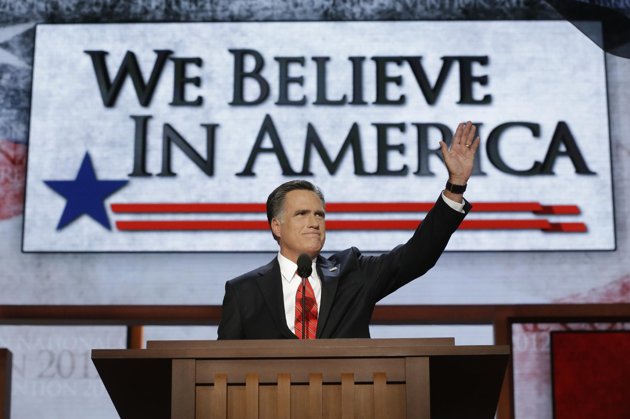
I Believe in America

Mitt Romney Believe in America
As many of you who know me well are aware, I am a bit of a history geek. This passion has led me to study intensively the history and founding of our nation. I believe deeply that it is important to remember that throughout our history, we as a people are responsible for the leaders we elect. The election we are now preparing for could possibly be the most important we have ever had, for it is a battle for the soul of America, or rather, it is a battle for what type of America we will have for us and future generations

I believe in our country, I believe in our proud heritage and I believe that America has the ability to continue to be a great nation. I believe we can be the best force for good in the world, and stand up for what is right and good. We can understand and believe that with the right leadership we can get headed in the right direction. To paraphrase Ronald Reagan, we can be the shining light on the hill to the rest of the world.

As we consider leaders, we often seek ones with experience, with leadership qualities we admire, and with a good ability to communicate. Today I will focus on experience though. When we think about the United States of America, it is a very large and complex body, comparable to a very large ship. It has many different moving parts, personnel that need leadership, and it needs direction and navigation both to move through the storms ahead, and to reach the destination we seek that of an America that is the beacon of hope to the world.

America deserves a captain that is familiar with the ship, its parts, its personnel, and has a clear view of the greatness that America can achieve. That is where Mitt Romney comes in. His experience in such various roles, from businessman to governor has prepared him to be a great leader in America. He has weathered storms as captain of the 2002 Olympics. He has an intricate knowledge of the economy, and a clear view of where we need to go in our future.

Our current president, on the other hand has come into this office with little to no real experience and America has suffered. It is not his fault the economy was suffering when he came into office, but it is time that we realize, under Obama things have not improved as they should have. Why? The reason is because we have had a captain that hasn’t known how, where and when to lead. He relies on his advisers to lead, which has led to some of them being out of control and unaccountable. He has attacked business owners and business in general. FDR once said “the business of America is business.” It seems to me that our current president’s opinion is that the business of America is to attack business.

Financially Obama has increased our debt more than any president, and he has done it in less than 4 years. What has it accomplished? Are we safer than we were four years ago? Is our economy better off than it
was four years ago? No. Having a captain who doesn’t know how to turn the ship around has led to Americans suffering to survive. Attacking crucial mechanizms through over regulation, burdensome tax standards, devaluing our currency, allowing other countries to bully us on economic policies, and leaving future generations with a load of debt that seems insurmountable, does not strengthen america.
In simple terms, we can’t afford to spend four more years on a president who doesn’t understand how the economy works, who doesn’t appreciate the entrepreneurial spirit, and who doesn’t seem to have a  clear view of where America should be heading.

We need a captain, a leader, someone who has been storm tested and has a definite view of the destination.
I believe in America,

do you?


Some reading I encourage
http://www.washingtonpost.com/blogs/right-turn/post/romneys-foreign-policy-the-opposite-of-obamas/2012/07/24/gJQAytNc6W_blog.html

http://www.washingtonpost.com/opinions/charles-krauthammer-did-the-state-make-you-great/2012/07/19/gJQAbZOiwW_story.html?wpisrc=nl_opinions

http://www.washingtonpost.com/opinions/charles-krauthammer-the-imperial-presidency-revisited/2012/07/05/gJQAR66PQW_story.html